bbdbuy Gym Shoe Stability: Sole Platform and Heel Lock
bbdbuy Gym Shoe Stability: Sole Platform and Heel Lock
bbdbuy Gym Shoe Stability: Sole Platform and Heel Lock
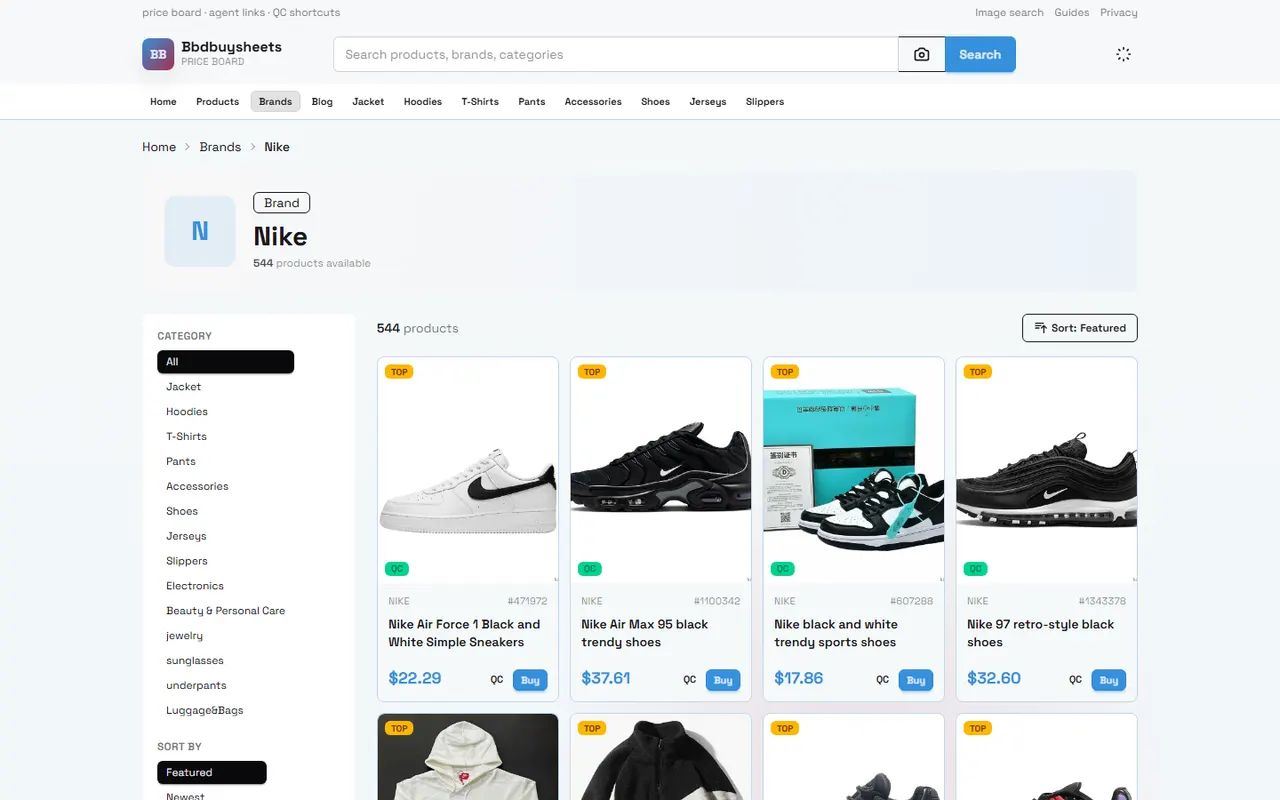
Image: Screenshot of the bbdbuy footwear catalog page, used to illustrate the product filtering entry point. It does not imply that any shoe shown has passed stability testing.
Verification date: October 6, 2026. This article discusses how to make a preliminary judgment about the support characteristics of training shoes based on product page information and QC images. It does not treat product titles, prices, brands, or single images as proof of performance.
First, Clarify Training Movements and Stability Needs
"Stability" in gym training shoes isn't about being as stiff as possible; it's about whether the sole, heel, and upper can reduce unnecessary movement during specific exercises. Squats, deadlifts, machine training, and lateral movements all place different demands on shoes.
If your main movements are squats or deadlifts, the focus is usually on whether the footbed contact is stable, whether the sole twists easily, and whether the heel stays in place. If your training is centered on machines, dumbbells, and short-distance movements, upper wrapping and lateral support become more important. If it includes running, jumping rope, or continuous jumping, you also need to separately consider cushioning, flex, and impact management—not just sole width.
This guide is for people who plan to browse gym shoes through the bbdbuysheets.com catalog and want to do an initial screening before ordering. It is not intended for judging medical orthotic needs, suitability for foot injuries, or as a substitute for professional fitting and sports medicine advice.
After reading, you should be able to do three things: first, exclude unsuitable shoe types based on your training movements; second, check visible structure using product pages and QC images; and third, narrow down candidates to those worth further verification.
Distinguish the Support Goals of Running Shoes, Training Shoes, and Everyday Shoes
Running shoes are typically designed around continuous forward rolling, cushioning, and repeated impact; everyday shoes serve appearance, commuting, and general walking. Training shoes have a more comprehensive goal, often aiming to balance forward/backward movement, lateral movement, and strength training.
Shoe Type | Features to Focus On | Conclusions Not to Directly Infer |
|---|---|---|
Running Shoes | Cushioning, rolling feel, weight, breathability | Not necessarily suitable for heavy squats or lateral stops |
Cross-Training Shoes | Sole contact area, lateral support, heel lock | Not necessarily suitable for long-distance running |
Weightlifting/Powerlifting Shoes | Heel height, sole hardness, torsion resistance | Not necessarily suitable for frequent jumping and agility training |
Everyday Sneakers | Appearance, comfort, commuter durability | Not necessarily providing sufficient training stability |
In the bbdbuy catalog, shoes may be filtered by brand, category, or product title. Catalog entry points can help you find candidate products, but categories alone cannot prove a shoe's structural performance. Words like "sport," "training," or "gym" in the title do not mean the page explains sole hardness, heel locking method, or lateral torsion resistance.
Examine the Sole Platform and Outsole Contact Area
When judging lateral stability, first look at whether the sole forms a relatively wide, continuous support platform from top to bottom. A sole that is too narrow, visibly tapers toward the middle, or has a large inward curve where the outsole edge meets the upper may reduce contact area during lateral movements. But this is only a visual clue and should not be used alone as a purchase conclusion.
You can observe the product main image and QC images in this order:
Check whether the forefoot and heel widths are significantly narrower than the upper.
Look for continuous rubber or durable areas along the outsole edge, especially on the lateral forefoot and lateral heel.
See if the midfoot is overly arched, causing the actual foot contact area to shrink.
Check if the sole appears obviously twisted or asymmetrical from the side.
Compare the sole outlines, tread patterns, and outer edges of the left and right shoes for consistency.
A wide platform does not necessarily mean stability. If the foam is too soft, the sole is too high, or the outsole is poorly bonded to the midsole, the shoe may still wobble under load. Conversely, a lower sole isn't always right for everyone, since individual ankle mobility, technique, and training program all influence the choice.
If the product page lacks side, top-down, and bottom views of the sole, don't infer torsion resistance from a front-facing upper photo. Record "missing key angles" as an item to verify rather than filling the gap with brand impressions.
Check the Heel Cup, Lacing System, and Foot Lockdown
During lateral movement, the sole provides the base contact area, while the heel cup and lacing system help keep the heel synchronized with the shoe body. When checking images, focus on whether the heel cup has clear boundaries, whether the collar collapses easily, and whether the lace holes cover a locking zone from the instep to the forefoot.
Visible features worth observing include:
Whether the left and right heel cup heights are equal and not obviously tilted outward.
Whether the collar padding is even, without one side collapsing or wrinkling.
Whether lace holes extend far enough forward to create multi-point lockdown.
Whether the tongue tends to shift to one side, causing uneven pressure when laced tight.
Whether the upper sidewall has support panels, binding, or a wide structural connection.
These features only suggest "looks like it might help lockdown"; they cannot prove comfort when worn or that different foot shapes will get the same wrap. People with high insteps, wide forefeet, or different left/right foot sizes should pay special attention to size charts, insole length, and width info. If the page lacks this data, mark it as insufficient information first.
Don't over-tighten the laces to compensate for a poor fit. Overtightening can cause local pressure and still won't solve heel slip or forefoot side-to-side movement inside the shoe.
Compare Trade-offs for Squats, Machine Training, and Lateral Movement
Squats and deadlifts rely more on footbed stability, sole torsion resistance, and heel position. If the sole is too soft or too high, it may be harder to feel changes in foot pressure under load. For those needing to maintain three-point foot contact, the sole platform and heel lock are usually more important to verify than looks or lightweight design.
Machine training and general strength work involve more varied movements. Cross-training shoes may offer a compromise between stability, comfort, and mobility, but you should still check whether the upper keeps the foot in place during lunges, step-ups, or single-leg exercises. Don't assume the upper can secure the heel just because the sole looks wide.
Lateral movement, agility ladders, and short direction changes depend more on outsole edges, upper sidewalls, and heel wrap. Those who change direction frequently should be cautious with candidates that have overly high soles, overly soft uppers, or overly narrow outsole edges.
Practical trade-offs can be made like this:
For strength-focused training: first check sole platform, torsion resistance clues, and heel lock.
For general cross-training: after stability, compare flex, weight, and breathability.
For lateral movement: prioritize outsole edge and upper lateral support.
For training that includes continuous running: don't use strength shoes as running shoe substitutes.
For foot pain or old injuries: don't decide based on product images alone; consult an appropriate professional first.
What Product Pages and QC Images Can Prove
bbdbuysheets.com is positioned as a platform to help users organize products, orders, and related shopping information. Catalog pages can be used to discover candidate products, and visible information like product name, category, price, and QC entry can help you build a preliminary screening record. Specific product details should be based on what is actually displayed when you open the product page, and re-verified before ordering.
Product pages are typically better for verifying these items:
Whether the product name and category match the training use.
Whether size, color, sole, or upper material information is provided.
Whether the page has multi-angle images rather than just one promo shot.
Whether price, available sizes, and page status are still valid.
Whether the corresponding purchase entry and QC-related info are visible.
QC images can help you check visible conditions, such as whether left/right shoes look consistent, whether the sole has obvious stains or deformation, whether upper stitching is split, and whether lace holes and heel show obvious damage. But QC images usually cannot prove post-wear stability, actual hardness, long-term durability, size comfort, or athletic performance.
If the images are from a single moment in time, you cannot infer that all batches, colors, or sizes are exactly the same. When comparing candidates, keep a record of the product number, color, size, and verification date associated with each image, to avoid using another product's photos as evidence for your current candidate.
Pre-Order Training Shoe Stability Checklist
Before ordering, record each item and pause if key conditions are not met:
Have I clearly identified my main training movement, not just written "gym"?
Does the sole have sufficient forefoot and heel contact area?
Can I see the sole from the side or bottom, not just a front promo image?
Is the heel cup complete and symmetrical, with no obvious collar collapse?
Does the lacing system cover the instep and allow segmented lockdown?
Does the product page provide usable size info and applicable conditions?
Have I re-confirmed the current price, stock, size, and page status on the verification date?
Do the QC images correspond to the same product, color, and size?
Have I separated image observations from performance conclusions?
If the shoe doesn't suit my movements, have I prepared an alternative?
It's recommended to classify each candidate into three groups: sufficient information, needs more images, and not suitable for now. This helps avoid ordering impulsively due to low price, popular name, or similar appearance.
Finalize Candidates Suitable for Your Training Plan
The final choice shouldn't be based solely on "which sole is widest," but on whether it satisfies three conditions: training movement, foot lockdown, and verifiable information. For squats and strength training, prioritize checking sole platform, torsion resistance, and heel position; for general cross-training, focus on the balance between stability and range of motion; for lateral movement, pay special attention to outsole edges and upper lateral support.
If two shoes have similar page information, prefer the one with more complete image angles, clearer size info, and easier QC verification. This typically saves not a fixed amount of money but the rework costs of buying the wrong size, choosing the wrong shoe type, or discovering insufficient information after arrival. The cost is that you might give up a lower-priced or more attractive candidate, or wait for more images or additional verification.
This screening method is better suited to users who want to keep records before ordering, are willing to choose shoe types based on training plans, and can accept "postpone purchase if evidence is insufficient." It is not recommended as a substitute for professional foot assessment, nor should you decide based solely on brand, title, and price when the product page lacks key images, size info is unclear, or QC cannot be matched to a specific product. 🏋️ 👟 🔍 ✅
Agent Platform Shopping FAQ
1. How can I tell if a product on bbdbuysheets.com is of good quality?
When judging product quality, check the QC photos instead of relying only on factory-provided images, which are often retouched. Use QC photos to confirm whether the product meets your specific requirements for details before deciding to actually purchase. Also, avoid extremely low-priced items, as they are usually of poor quality.
2. Why did bbdbuysheets.com abandon Google Sheets?
Google Sheets only works for small product lists. When the number of products grows, loading becomes very slow and system latency is noticeable, especially on mobile devices where display is poor and searching for items is extremely inconvenient. For the same products, the web sheets on bbdbuysheets.com load faster and look better.
3. Is the bbdbuysheets.com spreadsheet site safe?
This website does not collect any personal information; it only serves as a product catalog for the agent platform. All transactions take place on the agent platform.
4. What product types are available on bbdbuysheets.com?
The site offers a wide range of product categories, including shoes, T-shirts, sweaters, hoodies, jeans, sweatpants, shorts, board shorts, factory clearance items, down jackets, baseball shirts, shirts, hats, jewelry, bags, electronics, sunglasses, socks, underwear, and trendy collectibles.
5. What types of products can I find in the spreadsheet on bbdbuysheets.com?
The spreadsheet on bbdbuysheets.com covers footwear, clothing, bags, accessories, jerseys, perfumes, hats, scarves, belts, and various household items.
Browse our latest products and find your next favorite item.